



Swap a 30 cm SDR lead for a 5 m run to a window antenna and weak stations can disappear. Nothing is broken: coax loses power along its length, and it loses more the higher the frequency. The datasheet for the RG316 assemblies we stock also lists a 5 m length (not a stock option), rated at most 4.65 dB of loss at 1 GHz and 7.85 dB at 3 GHz, so at 3 GHz only about 16% of the power comes out. This page shows how to read cable loss from a datasheet, why it rises with frequency, and what it costs a receiver.
Reading loss from a datasheet
Cable-assembly datasheets list a maximum insertion loss for several lengths at a few frequencies. Plot the numbers against length and they fall on a straight line, because loss in dB adds up metre by metre. The slope is the cable’s loss per metre; the line does not go through zero, because the two connectors and their transitions add a fixed part. For the RG316 assemblies we stock at 1 GHz the fit gives 0.89 dB/m plus about 0.18 dB for the connectors; at 3 GHz the per-metre figure rises to 1.52 dB/m.
Loss (dB) ≈ connector part + loss per metre × length
| Cable (assemblies we stock) | Rated range | 1 m at 1 GHz | 1 m at 3 GHz | 5 m at 3 GHz |
|---|---|---|---|---|
| RG316, SMA–SMA | DC–3 GHz | 1.05 dB | 1.75 dB | 7.85 dB |
| RG178, SMA–U.FL (IPEX) | DC–6 GHz | 1.70 dB | 2.95 dB | not listed |
| .085 semi-flexible, SMA–SMA | DC–26.5 GHz (loss listed to 18 GHz) | not listed | 1.33 dB | not listed |
All values are datasheet maximums, not measurements of a particular cable. Not every length in the table is a stock option; the point is the trend.
Why loss rises with frequency
Two things turn signal into heat in a coax. The first is the resistance of the conductors. At radio frequencies the current crowds into a thin layer at the surface of each conductor (the skin effect), and that layer gets thinner as the frequency goes up, roughly as 1/√f. Less copper carrying the current means more resistance, so this part of the loss grows as √f. The second is the dielectric between the conductors, whose loss grows in proportion to f. In PTFE-insulated cable like the ones here, the dielectric part is small, and the conductor part dominates.
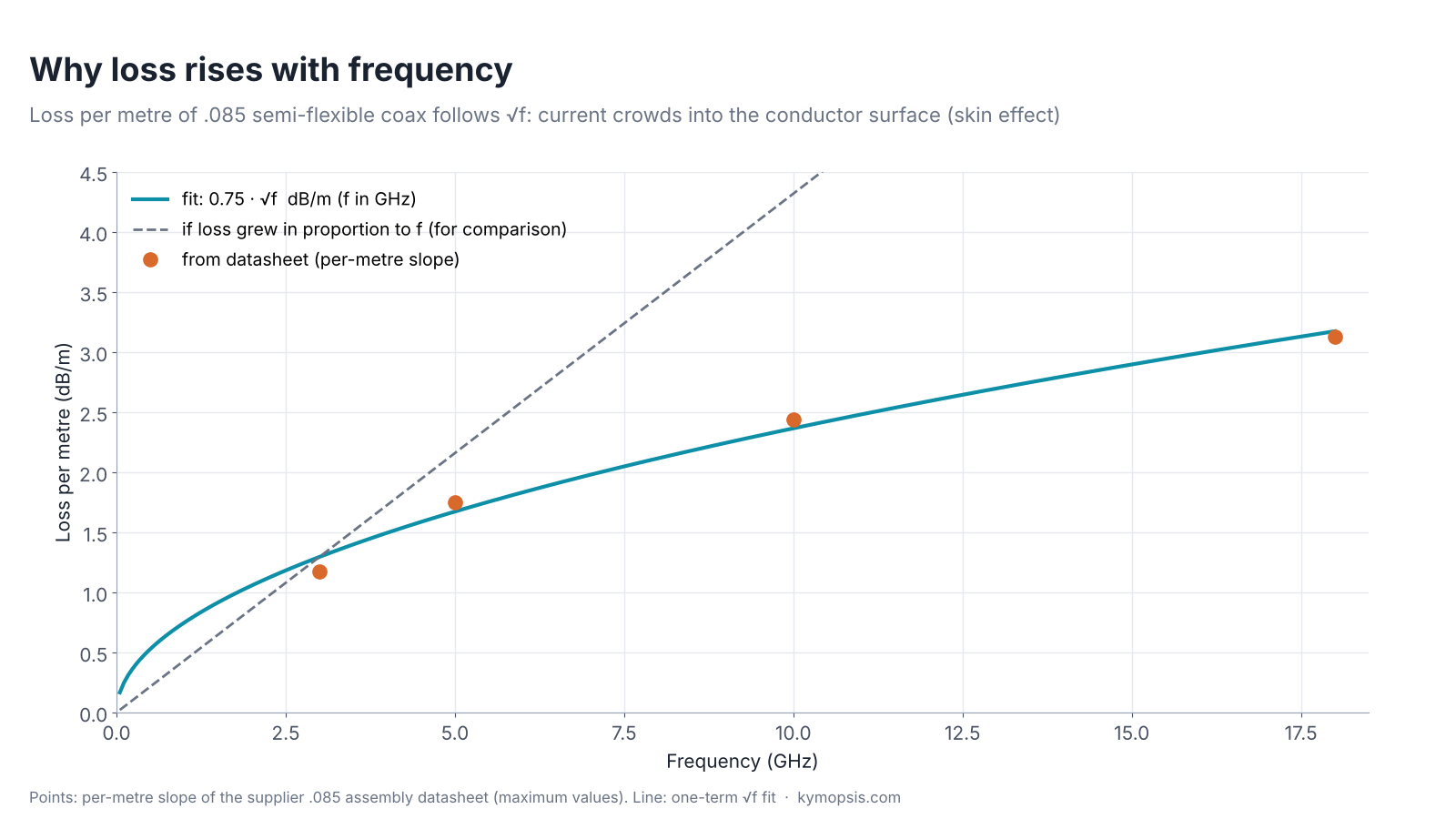
The .085 datasheet values bear this out: the per-metre loss at 3, 5, 10 and 18 GHz follows 0.75·√f dB/m to within about 10%. Going from 3 to 18 GHz multiplies the frequency by six but the loss by only about 2.7. A practical consequence: if you know the loss of a cable at one frequency, √f scaling gives a fair estimate at nearby frequencies for this kind of cable, but the datasheet value always wins where it exists.
Thinner cable loses more. RG178 has a smaller centre conductor than RG316, and its datasheet loss per metre is about 1.6 times higher at 1 GHz. That is fine for the short pigtails it is made for, between a U.FL socket on a board and an SMA on the case, and a poor choice for a long run.
What loss costs a receiver
On receive, a cable reduces the signal but the receiver’s own noise stays where it is, so the signal-to-noise ratio drops. A lossy cable at room temperature also adds its own thermal noise, and the two effects together mean its noise figure equals its loss: 2 dB of cable in front of a receiver raises the system noise figure by about 2 dB, and a weak signal ends up about 2 dB closer to the noise (exactly so when the antenna sees about room-temperature noise; at HF, where outside noise dominates, cable loss costs less).
Where the loss sits matters. The Friis formula for cascaded stages says the first stage sets most of the noise figure, and later stages count less in proportion to the gain in front of them:
Ftotal = F1 + (F2 − 1)/G1 + (F3 − 1)/(G1G2) + … (F and G as linear ratios, not dB)
With the cable first, its loss adds almost directly to the noise figure. With a low-noise amplifier at the antenna and the cable after it, the cable’s contribution is divided by the amplifier’s gain and mostly disappears. That is why satellite dishes and GPS antennas put the amplifier at the antenna and feed it power up the coax, which is what a bias tee is for.
On transmit the arithmetic is simpler: the loss is power that becomes heat in the cable instead of leaving the antenna. For level setting on the bench, cable loss is a fixed attenuation like a pad; our attenuator explainer covers the dB arithmetic.
Choosing a cable
- Keep runs short (the SMA cables we stock come in 10 cm to 1 m lengths), and check the rated frequency range: the RG316 assemblies we stock are rated to 3 GHz, so 5.8 GHz needs another cable.
- Above a few gigahertz, or for test leads on a VNA, use semi-flexible .085 cable; it holds its shape, so it is not flexed between calibration and measurement.
- Use thin RG178 only for short pigtails from U.FL sockets.
- For a long run to a receive antenna, put the amplifier at the antenna end rather than buying ever thicker cable.
- Every adapter in the path adds a little loss too; count them.
For VNA test cables in particular, see our NanoVNA accessories guide.
-
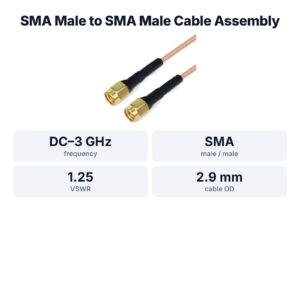
SMA Male to SMA Male Cable Assembly, RG316 Series Flexible Coax Cable, DC–3 GHz
From $22.00Reset options200 mm300 mm500 mm800 mm1000 mm1200 mm1500 mm2000 mmSelect options This product has multiple variants. The options may be chosen on the product page -
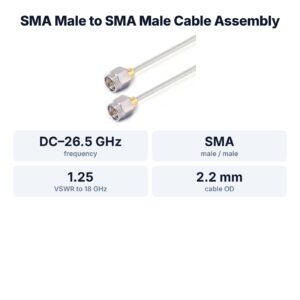
SMA Male to SMA Male Cable Assembly, .086″ Semi-Flexible Coax Cable Without FEP Jacket, DC–26.5 GHz
From $42.00Reset options100 mm150 mm200 mm250 mm300 mm400 mm500 mm800 mm1000 mmSelect options This product has multiple variants. The options may be chosen on the product page
FAQ
Why does coax lose more at higher frequency?
Current flows in a thinner surface layer as frequency rises (skin effect), so conductor resistance grows roughly as √f. Dielectric loss grows as f but is small in PTFE cable.
How do I find loss per metre from a datasheet?
Take the listed losses at two lengths at the same frequency; the difference divided by the length difference is the loss per metre. What remains at zero length is the connectors.
Does a short SDR cable matter?
Less than a long one. The RG316 datasheet rates 1 m at most 1.05 dB at 1 GHz and 5 m at most 4.65 dB (we stock lengths up to 1 m). Before the first amplifier, that difference shows up almost directly in sensitivity.
Is RG178 worse than RG316?
For loss, yes: about 1.6 times more per metre at 1 GHz on the datasheets. It is thinner and suited to short pigtails.
Sources and method
- Supplier cable-assembly datasheets: RG316 SMA–SMA (DC–3 GHz), RG178 SMA–U.FL (DC–6 GHz), .085 semi-flexible SMA–SMA (DC–26.5 GHz; VSWR and loss specified to 18 GHz); maximum insertion loss by length and frequency.
- D. M. Pozar, Microwave Engineering, 4th ed., Wiley, 2012: transmission-line loss, skin effect, noise figure of a lossy line, Friis formula.
Per-metre values and the √f fit are least-squares fits to the datasheet maximums; nothing here is a measurement.