

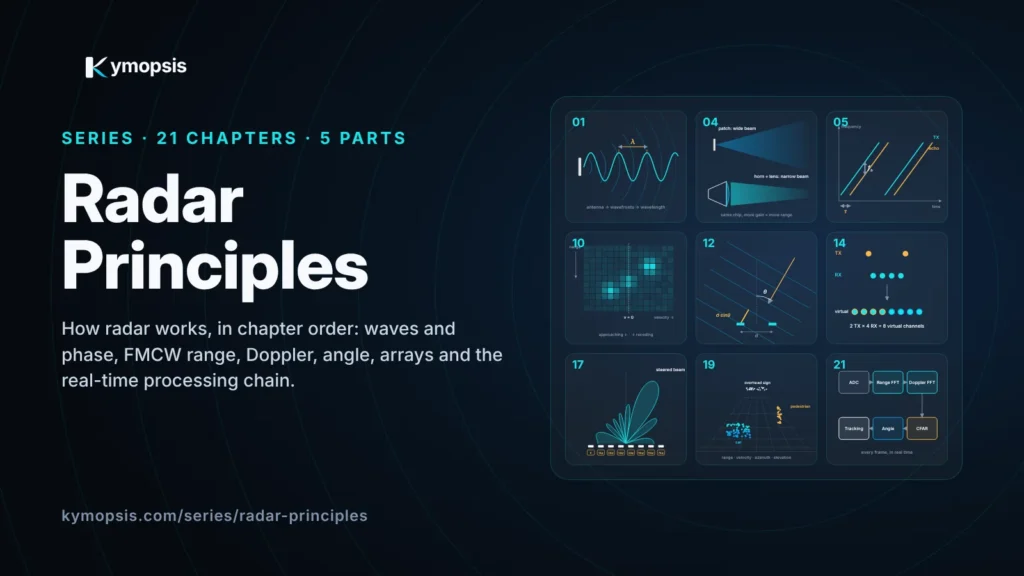
Radar Principles
The full course for engineers: waves and phase, FMCW ranging, Doppler, angle, MIMO and arrays, and the real-time chain from CFAR to tracks, with formulas, simulations and real 60 and 80 GHz modules.
Part A · Waves, signals and antennas
- 1Radar Principles 1: How Radio Waves Are Made and Why They’re Millimetres LongWhere a radar wave comes from, how it spreads, why the echo falls as 1/R⁴ and why 60–80 GHz antennas are about a millimetre long.

- 2Radar Principles 2: Phase, I/Q and the Complex Radar SignalWhat echo phase is, why it turns once per half wavelength, why radars sample I and Q, and how imbalance and offsets distort phase readings.
- 3Radar Principles 3: Interference, Multipath and Ghost TargetsHow radar echoes add as phasors, why two antennas make lobes and nulls, why a floor makes the echo fade, and where ghost targets come from.
- 4Radar Principles 4: Antenna Gain and Beamwidth, and Why the Antenna Sets an 80 GHz Level Radar’s RangeTwo 80 GHz radar level sensors share one chip but are rated 20 m and 60 m. The reason is the antenna: split TX/RX patches versus one horn feeding a lens.
Part B · Measuring range
- 5Radar Principles 5: FMCW Chirps and the Beat FrequencyHow an FMCW radar turns echo delay into a beat frequency: the mixer, the IF filters, ADC sampling and aliasing, and how they set the maximum range.

- 6Radar Principles 6: The Range FFT and Range ResolutionHow an FMCW radar turns beat samples into range bins, why resolution is c/2B, when two targets merge, and what windows and zero padding really do.
- 7Radar Principles 7: The Radar Equation and Signal-to-Noise RatioWhere a radar's echo power and noise come from, why integrating chirps adds 10·log10(N) dB, and how much SNR detection and precise measurement need.
- 8Radar Principles 8: Precise Range Inside One Range BinHow FMCW radars read distance far finer than the range bin: peak interpolation, the Cramér–Rao bound, the threshold effect and the errors that remain.
- 9Radar Principles 9: FMCW Phase Measurement, From Centimetre Bins to MicronsHow an FMCW radar with 3 cm range bins measures sub-millimetre motion: peak interpolation, echo phase, the SNR bound, and its use in level gauges, vital-sign…
Part C · Measuring velocity
- 10Radar Principles 10: Doppler, Slow Time and the Range-Doppler MapHow an FMCW radar measures velocity from the phase change between chirps, builds a range-Doppler map, and why fast targets wrap around.

- 11Radar Principles 11: Micro-Doppler, Gestures and Vital SignsHow radars see limbs, hand gestures and breathing: spectrograms, why a still person is hard to detect, and how phase tracks millimetre chest motion.

Part D · Angle, radomes and MIMO
- 12Radar Principles 12: Angle of Arrival from a Phase DifferenceHow an FMCW radar measures angle from the phase gap between receive antennas: λ/2 spacing, ambiguity, precision versus SNR, two targets in one cell, and what…

- 13Radar Principles 13: Radome Design for 24–80 GHz RadarHalf-wave wall thickness for PTFE, PP, ABS and PC at 60 and 77 GHz, thickness tolerance, incidence angle, mounting distance, paint and water films, with the …

- 14Radar Principles 14: MIMO Radar and the Virtual ArrayHow MIMO radar turns N TX and N RX antennas into N×N virtual channels: TX+RX positions, TDM, BPM and DDM, the velocity and motion costs of TDM, and what it m…

- 15Radar Principles 15: Ambiguity in Range, Velocity and Angle, and How to Unfold ItWhy radar range, velocity and angle readings wrap around, how two chirp intervals and two baselines unfold them, and why TDM-MIMO ties velocity to angle.

Part E · Advanced techniques
- 16Radar Principles 16: Detection and Tracking with CFAR and Kalman FiltersHow a radar decides which range-Doppler cells hold a target: false-alarm rates, CA and OS-CFAR, static clutter removal, and turning detections into stable tr…

- 17Radar Principles 17: Beamforming and Phased ArraysHow antenna arrays steer beams with phase: steering weights, beamwidth and scan loss, grating lobes, tapering, beam squint, analog vs digital beamforming, an…
- 18Radar Principles 18: Super-Resolution with Capon, MUSIC and ESPRITHow Capon, MUSIC and ESPRIT separate targets closer than the FFT's 2/N limit, and what they need: SNR, snapshots, incoherent echoes or spatial smoothing, the…

- 19Radar Principles 19: 4D Imaging Radar and Point Clouds from Large MIMO ArraysWhat 4D imaging radar measures, why it needs cascaded MIMO arrays, and how range-Doppler maps, CFAR, motion compensation and azimuth/elevation estimation tur…

- 20Radar Principles 20: Choosing 24, 60 or 77–81 GHzHow the radar band sets antenna size, beamwidth, gain, range resolution and Doppler, what the FCC and ETSI rules allow at 24, 60 and 76–81 GHz, and how to ch…

- 21Radar Principles 21: The Real-Time Processing Chain: CFAR, Angle and TrackingHow an FMCW radar turns a frame of samples into a list of tracked objects: range-Doppler FFT, 2-D CFAR, angle only at detections (MIMO, phased array and mono…