


Most radar projects pick a frequency band before anything else, often by picking a module. That choice fixes more than the price. The band sets the wavelength, and the wavelength sets the antenna size, the beam you get from a given board area, the Doppler shift per metre per second and the radome thickness. The regulations for each band set how much sweep you may use, and the sweep sets the range resolution. In short: 24 GHz is cheap and mature but limited to 250 MHz; 60 GHz gives fine resolution and tiny antennas for indoor sensing; 76–81 GHz gives the narrowest beam per millimetre of antenna and is the band for vehicles and precise level measurement.
This is chapter 20 of Radar Principles, and the last of the first edition. It reuses results from almost every earlier chapter: wavelength, the radar equation, range resolution, Doppler, antenna gain and beamwidth and radomes. The numbers come from a short script (ch20_frequency_bands.py) so you can change the assumptions.
The wavelength sets the size of everything
A bass guitar’s strings are long and thick for low notes, a ukulele’s short and thin for high ones. Antennas follow their wave in the same way: at a higher frequency the waves are shorter, so every antenna, every spacing and every cover shrinks with them.
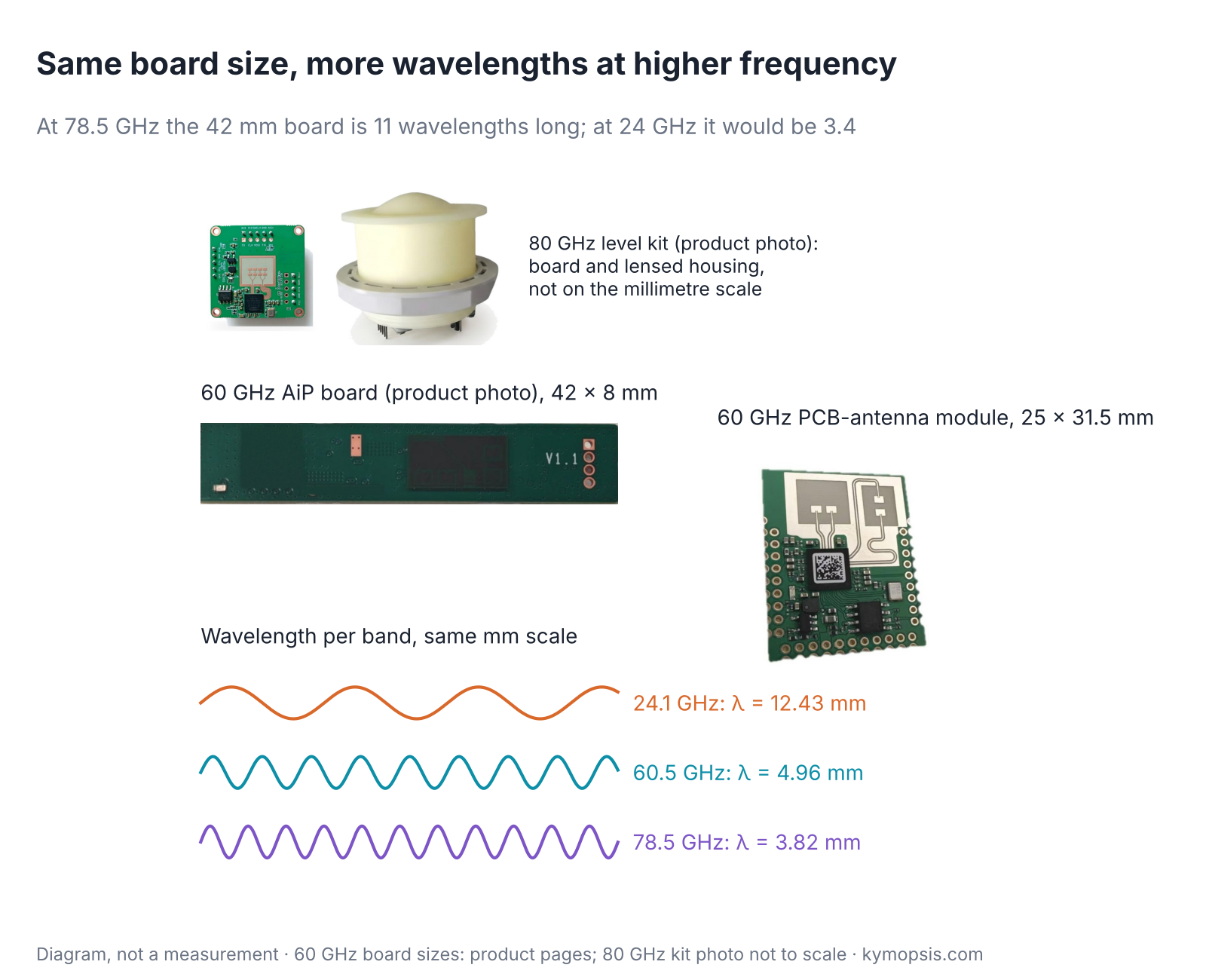
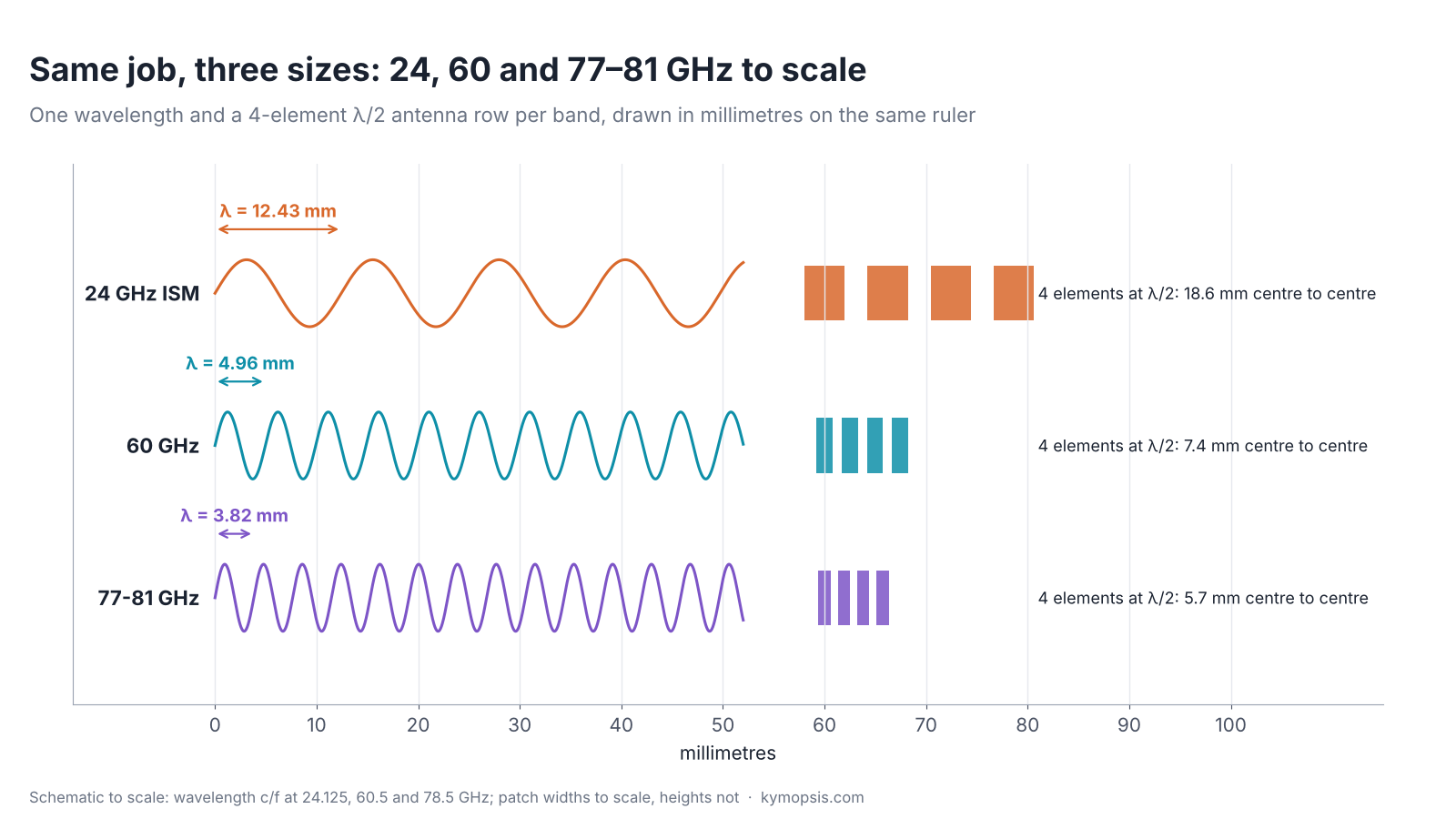
Antenna elements are sized and spaced in wavelengths: patches about λ/2 long in the substrate, arrays at λ/2 pitch to avoid angle ambiguity. At 24 GHz a four-element row spans 18.6 mm between outer centres; at 60 GHz it is 7.4 mm, small enough to put the antennas in the chip package (AiP); at 78.5 GHz it is 5.7 mm. That is why 60 and 77 GHz radars fit in a thumbnail-sized module and why a 24 GHz module with any directivity is the size of a matchbox.
Size cuts both ways. Smaller features need tighter manufacturing: a 0.1 mm etching error is about 1% of a wavelength at 24 GHz and nearly 3% at 78.5 GHz. Board losses rise with frequency, so 77 GHz designs need low-loss RF laminates or antennas in the package, and connectors give way to waveguides. These are the main reasons a 77 GHz front end costs more than a 24 GHz one.
What the band decides
A ruler with finer marks measures small things more precisely. Shorter waves are finer marks: more phase per millimetre of motion, more Doppler shift per step of speed and more gain from the same antenna area. Range resolution is the exception: it comes from how wide the sweep is, not from the carrier.
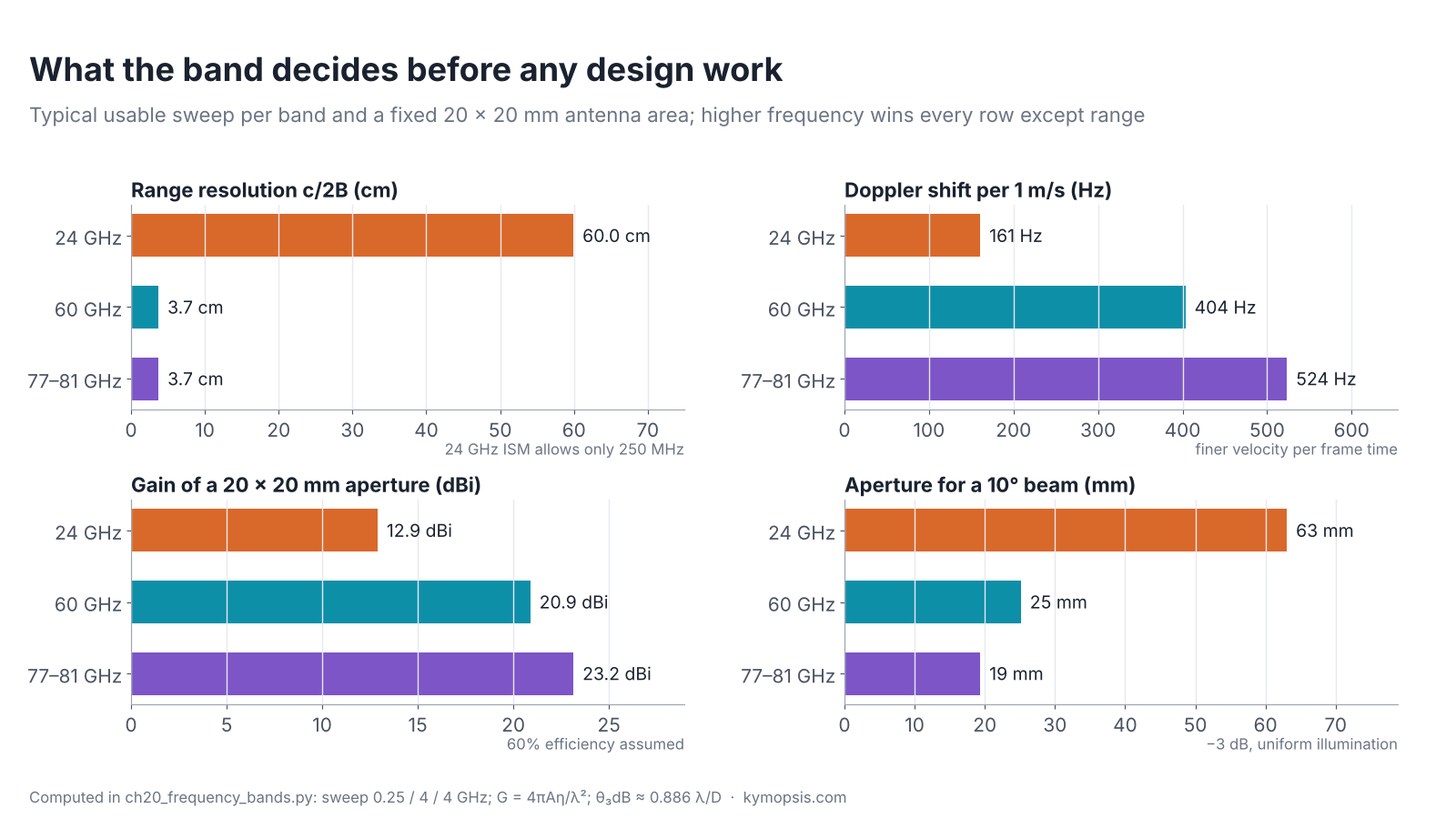
Four quantities follow, each from a formula used earlier in the series:
- Range resolution is c/2B (chapter 6). It depends on the sweep B, not the carrier, but the sweep available depends on the band. The 24 GHz ISM band is 250 MHz wide, so 60 cm is the floor. The 57–64 GHz band and the 77–81 GHz band both allow sweeps of several gigahertz; with 4 GHz the resolution is 3.7 cm, and the full 5 GHz of 76–81 GHz gives 3.0 cm.
- Doppler per m/s is 2/λ (chapter 10): 161 Hz at 24 GHz and 524 Hz at 78.5 GHz. For the same frame time, velocity resolution λ/2T is about three times finer at 77 GHz. The same holds for phase: one full phase cycle is λ/2 of motion, 6.2 mm at 24 GHz and 1.9 mm at 78.5 GHz, which helps vital-sign sensing at 60 GHz and above.
- Gain of a fixed area is G = 4πAη/λ² (chapter 4). With the area fixed, gain rises with f²: +8.0 dB from 24 to 60.5 GHz and +10.2 dB from 24 to 78.5 GHz. This partly offsets the higher losses in the radar equation.
- Beamwidth of a fixed aperture is about 0.886λ/D. A 20 mm antenna gives about 32° at 24 GHz and 10° at 78.5 GHz. Put the other way, a 10° beam needs 63 mm of antenna at 24 GHz and 19 mm at 78.5 GHz.
Where the numbers come from
Wavelengths use 24.125, 60.5 and 78.5 GHz, the band centres. Gain assumes a 20 × 20 mm aperture with 60% aperture efficiency; beamwidth assumes uniform illumination of a 20 mm length (θ₃dB ≈ 0.886 λ/D in radians). A tapered aperture has a wider beam and lower sidelobes. Sweeps are 0.25, 4 and 4 GHz, a common usable span for single-chip radars in each band; check your chip’s datasheet for its maximum.
What the rules allow
Roads have lanes and speed limits, and the radio spectrum has bands with rules for who may use them and how wide. Which band a radar may use, and how much of it, is set by those rules, which differ from country to country and change over time.

Radio rules decide what each band can be used for, and they change. The overview below is for orientation only; check the current rule text for your market and product category.
| Band | United States (FCC) | Europe (ETSI standard) | Typical uses |
|---|---|---|---|
| 24.0–24.25 GHz | Part 15.249 (15.245: 24.075–24.175 GHz) | EN 300 440 (SRD) | Motion and door sensors, simple speed and distance |
| 57–64 GHz (US: up to 71) | Part 15.255; 2023 rules widened radar use | EN 305 550 (SRD) | Presence, gesture, vital signs, in-cabin sensing |
| 76–81 GHz | Part 95 Subpart M (vehicle radar) | EN 301 091 (76–77), EN 302 264 (77–81) | Vehicle radar; industrial radar where permitted |
| 75–85 GHz | Part 15.256 (level probing radar) | EN 302 729 (LPR) | Level measurement in open air and tanks |
Two points matter for design. First, the old wide 24 GHz automotive band (ultra-wideband short-range radar around 21.65–26.65 GHz) has been phased out for new designs in both the EU and the US, so outside level probing radar (24.05–29 GHz under §15.256 and EN 302 729) a new 24 GHz sensor is limited to the 250 MHz ISM band. Most automotive radar has moved to 76–81 GHz. Second, the 76–81 GHz vehicle-radar rules are written for vehicles; non-vehicle uses in the same band, such as level radar, come under separate rules with their own conditions.
Any finished product still needs its own certification in each market; the module datasheet and the target market’s rules decide what a product built on a given module may do.
Absorption, rain and materials
Deep bass from a neighbour’s party comes through the wall, while the high notes do not. Higher-frequency radar waves likewise lose more in rain, in thick plastic and in walls, and around 60 GHz the oxygen in the air itself soaks up a little.

Oxygen has a set of absorption lines around 60 GHz, about 15 dB/km at sea level. That is why 60 GHz is used for short links that should not interfere with each other far away. For a radar that works across a room it makes little difference: 0.3 dB at 10 m, against the 12 dB lost for every doubling of range in the radar equation. At 100 m it reaches 3 dB two-way, which starts to matter, and 24 or 77 GHz is the better choice for long outdoor ranges.
Rain attenuates all three bands, more at higher frequency: heavy rain (25 mm/h) costs roughly 3–4 dB/km at 24 GHz and about 10 dB/km at 77 GHz, still well under 0.5 dB two-way at 10 m. Water films and ice on the radome are a bigger problem than rain in the air. Materials matter more: lower frequencies pass through thicker plastic, wood and drywall with less loss, and a half-wave radome is thicker and easier to make. For a cover with εr = 3, λ/2 in the material is about 3.6 mm at 24 GHz, 1.4 mm at 60.5 GHz and 1.1 mm at 78.5 GHz, so the same tolerance in thickness is a larger fraction of the wavelength at higher frequency.
How to choose
Choosing a band is like choosing a vehicle: a bicycle for short cheap trips, a car for the motorway, a van for a heavy load. Cheap motion sensing, fine indoor sensing and a narrow beam from a small antenna each point to a different band.
| If you need… | Start with | Why |
|---|---|---|
| Low-cost motion or presence, no fine detail | 24 GHz | Mature, cheap parts; 60 cm resolution is enough |
| Indoor presence, people counting, gesture, breathing | 60 GHz | Several GHz of sweep, small AiP antennas, fine phase per mm |
| Narrow beam from a small antenna; precise level | 76–81 GHz | Highest gain per area, 3–4 cm resolution, low absorption |
| Vehicle radar | 76–81 GHz | Where the rules and the automotive chip ecosystem are |
| Through thick plastic or walls | 24 GHz (or lower) | Lower material loss, thicker tolerable radomes |
Range itself is rarely the deciding factor at these distances. The deciding factors are what has to be resolved (range resolution and beamwidth), how much space the antenna gets, what the cover is made of, and which rules apply. Chapter by chapter, this series has given the tools to put numbers on each of them.
Try it yourself: examples/ch20_frequency_bands.py in the open-source radar-basics-sim repository runs the core simulation of this chapter; change the assumptions and see what moves.
How this maps to the kits we sell
Our shelf is short: 60 GHz boards for sensing in a room, and an 80 GHz level kit for a narrow beam into a tank.
The 60 GHz kits we sell cover the indoor case: the 60 GHz AiP module with antennas in the package for gesture and presence, and the 60 GHz PCB-antenna module for ceiling presence. The 80 GHz level radar kit works in 76–81 GHz: its 60 m version uses a horn and lens for a narrow beam, its 20 m version a PCB patch antenna, and a narrow beam is what a tank or open-channel level sensor needs. For bench work, the horn antennas we stock cover K-band (18–26 GHz) and 60–90 GHz. The radar desk buddy project shows a 60 GHz module in a complete open-source build.
-

60 GHz AiP Gesture & Presence Radar Sensor Module, Pre-flashed (57–64 GHz, 2T2R)
From $19.00Sensor onlySensor + USB-TTL adapter (3.3 V LDO)Reset optionsGesture recognitionPresence, ceiling mountPresence, wall mountPresence and fall events, ceiling mountBreathing and heart rate (research)Select options This product has multiple variants. The options may be chosen on the product page -

80 GHz Radar Level Sensor Development Kit, 76–81 GHz, 20 or 60 Meter Range
From $99.00Reset options60-meter kit, horn + lens20-meter kit, lens radomeSelect options This product has multiple variants. The options may be chosen on the product page
FAQ
Is 77 GHz radar better than 24 GHz?
For resolution and antenna size, yes: up to 4–5 GHz of sweep instead of 250 MHz and about a third of the antenna size for the same beam. 24 GHz stays cheaper, penetrates materials better and is enough for simple motion and distance sensing.
Does 60 GHz radar work through walls?
Poorly. Thin plastic, glass and fabric are fine with the right thickness, but drywall, wood and especially concrete attenuate 60 GHz strongly. Lower bands pass through better.
Does oxygen absorption make 60 GHz radar useless outdoors?
No. It adds about 15 dB/km, so 0.3 dB two-way at 10 m and 3 dB at 100 m. It matters for long outdoor ranges, not for room-scale sensing.
Why is range resolution the same at 60 and 77 GHz?
Range resolution is c/2B and depends only on sweep bandwidth. With the same 4 GHz sweep both give 3.7 cm; the full 5 GHz of 76–81 GHz gives 3.0 cm.
Sources and method
- U.S. eCFR, 47 CFR Part 15 (§15.245, §15.249, §15.255, §15.256) and Part 95 Subpart M (ecfr.gov); FCC Report and Order FCC 23-35 (2023) on 57–71 GHz radar.
- ETSI EN 300 440, EN 305 550, EN 301 091, EN 302 264 and EN 302 729 (etsi.org); CEPT ERC Recommendation 70-03.
- ITU-R Recommendation P.676, ‘Attenuation by atmospheric gases’, and P.838 (rain).
- Texas Instruments, “Moving from legacy 24-GHz to state-of-the-art 77-GHz radar” white paper (ti.com).
- C. A. Balanis, Antenna Theory: Analysis and Design, 4th ed., Wiley, 2016.
Numbers are computed with ch20_frequency_bands.py from the formulas given; absorption values are approximate sea-level clear-air figures. The allocation chart is a simplified schematic, not legal advice.