

Radar & RF Fundamentals
How radar works, step by step: waves and phase, FMCW ranging, Doppler, angle, MIMO and arrays, with simulations and our 60 and 80 GHz modules.
Read a series
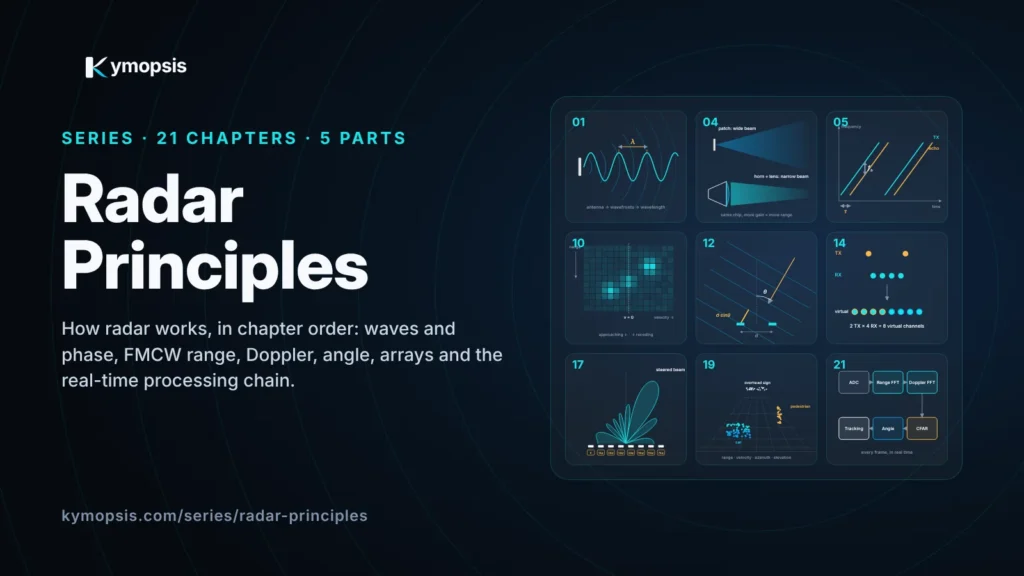
Series · 21 chapters · 5 partsRadar PrinciplesThe full course for engineers: waves and phase, FMCW ranging, Doppler, angle, MIMO and arrays, and the real-time chain from CFAR to tracks, with formulas, simulations and real 60 and 80 GHz modules.Start with Chapter 1 →Series page →
All 21 chapters
Part A · Waves, signals and antennas
- 1Radar Principles 1: How Radio Waves Are Made and Why They’re Millimetres Long
- 2Radar Principles 2: Phase, I/Q and the Complex Radar Signal
- 3Radar Principles 3: Interference, Multipath and Ghost Targets
- 4Radar Principles 4: Antenna Gain and Beamwidth, and Why the Antenna Sets an 80 GHz Level Radar’s Range
Part B · Measuring range
- 5Radar Principles 5: FMCW Chirps and the Beat Frequency
- 6Radar Principles 6: The Range FFT and Range Resolution
- 7Radar Principles 7: The Radar Equation and Signal-to-Noise Ratio
- 8Radar Principles 8: Precise Range Inside One Range Bin
- 9Radar Principles 9: FMCW Phase Measurement, From Centimetre Bins to Microns
Part C · Measuring velocity
- 10Radar Principles 10: Doppler, Slow Time and the Range-Doppler Map
- 11Radar Principles 11: Micro-Doppler, Gestures and Vital Signs
Part D · Angle, radomes and MIMO
- 12Radar Principles 12: Angle of Arrival from a Phase Difference
- 13Radar Principles 13: Radome Design for 24–80 GHz Radar
- 14Radar Principles 14: MIMO Radar and the Virtual Array
- 15Radar Principles 15: Ambiguity in Range, Velocity and Angle, and How to Unfold It
Part E · Advanced techniques
- 16Radar Principles 16: Detection and Tracking with CFAR and Kalman Filters
- 17Radar Principles 17: Beamforming and Phased Arrays
- 18Radar Principles 18: Super-Resolution with Capon, MUSIC and ESPRIT
- 19Radar Principles 19: 4D Imaging Radar and Point Clouds from Large MIMO Arrays
- 20Radar Principles 20: Choosing 24, 60 or 77–81 GHz
- 21Radar Principles 21: The Real-Time Processing Chain: CFAR, Angle and Tracking
Series · 1 articleRadar MathThe mathematics behind Radar Principles, one idea per post: the FFT and DFT, sampling, windows, phase arithmetic and estimation limits, each worked through with a radar example.Start with Chapter 1 →Series page →