



Point a radar at a person sitting still and the range-Doppler map from chapter 10 shows almost nothing: the body is not going anywhere. Yet a 60 GHz module can tell that the person is there, that they are breathing, and in a lab even roughly how fast their heart beats. The trick is to stop asking how fast the target is moving and start asking how its parts move: swinging limbs, a waving hand, a chest rising by a few millimetres. This chapter covers these small motions, called micro-Doppler and micro-motion, and why they are both the hardest and the most interesting part of short-range radar.
Beyond one velocity per target
Watch a person walk past a shop window. The body glides along at one steady pace, but each foot stops on the ground and then dashes ahead, and the arms swing back while the body goes forward. A speed gun gives one number for the whole person; a radar that listens closely hears every part at its own speed, rising and falling with each step.
A range-Doppler map gives each reflector one velocity per frame. Real targets are made of parts that move differently. A walking person’s torso moves at walking speed, but each leg swings forward faster than the torso and then stops while the foot is planted; the arms swing the other way. A fan’s blade tips trace circles. Each part produces its own Doppler shift, and those shifts change over the cycle of the motion. This modulation of the Doppler signature by small motions is micro-Doppler.
It is useful because it is characteristic. A walking person, a dog, a swaying plant and a ceiling fan can have the same overall speed but very different micro-Doppler patterns, which is how radars classify what they see without a camera.
Spectrograms
Wave at a radar and different parts of your hand move at different speeds at the same moment: the wrist slowly, the fingertips fastest. Draw those speeds over time, towards the radar up and away down, and a wave paints a zigzag, a push is one burst towards the radar and back, and a walking person is a steady line with arms and legs weaving around it. That picture is the spectrogram, and it is what a gesture classifier learns from.
To see micro-Doppler, take the slow-time signal of one range bin (the chirp-by-chirp values from chapter 10), cut it into short overlapping windows, and compute a Doppler spectrum for each. Stacked against time, the spectra form a spectrogram: time across, velocity up, colour for strength. The figure at the top is the spectrogram of a simulated walker: a bright line for the torso at 1 m/s and the weaving traces of four limbs around it, repeating once per step.
The window length is a trade, as always with Fourier analysis. Short windows follow fast changes but blur velocity; long windows resolve velocity finely but smear the motion over time. Typical micro-Doppler work uses windows of 50–200 ms. The chirp rate must also be high enough that the fastest part, often a foot or a hand, stays within ±vmax, or it wraps around (chapter 15).
Gestures
Think of pushing a child on a swing: your hand rushes forward, stops, and comes back. Towards the radar and then away is the whole shape of a push; a pull is the same shape the other way round, and a swipe also slides sideways across the sensor. A gesture sensor recognises these shapes the way you recognise a friend from their walk before you can see their face.
A hand moving above a sensor is a small target with a large, fast and very structured motion. Pushing towards the radar and back gives a negative then positive velocity swing; pulling away gives the reverse. Swipes add a change in angle and range on top.

Gesture sensors combine these velocity signatures with range and angle over time and feed them to a classifier, from simple rules to small neural networks. Antenna-in-package modules suit this well: the sensor is small enough to hide behind a cover, and two receive antennas give left-right information. Our open-source gesture demo builds on the pre-flashed 60 GHz AiP sensor below.
Why a still person is hard to see
Think of a cat asleep on a sofa: from across the room it looks like a cushion. Watch for a while and its side rises and falls; the cushion never moves. A simple motion sensor looks for a moment and sees a cushion. A presence radar watches for several seconds and sees the breathing.
A person sitting at a desk barely changes range. Their echo lands on the zero-velocity line of the range-Doppler map, together with the desk, the chair and the wall. Static clutter removal, which subtracts the average over chirps, removes the person along with the furniture. That is why simple motion sensors switch the light off when you sit still for too long.
Presence radars get around this by looking much longer and much more finely. Over several seconds, even a still person’s echo is not perfectly constant: breathing moves the chest, the body sways slightly, and the phase of their range bin wanders. A furniture echo’s phase stays fixed. Measuring the phase variation of each range bin over a few seconds therefore separates a living person from an empty chair, even at zero average velocity.
Breathing and heartbeat from phase
A calm breath moves the chest only about four millimetres each way. The echo travels there and back, so its path changes by twice that, and at 60 GHz one wave is only five millimetres long: each breath swings the echo by more than a whole wave, even through a blanket, because dry cloth lets these waves through while the water in skin reflects them. The heartbeat rides on top as a much smaller ripple, about a third of a millimetre. This is research, not a medical device.
Breathing moves the chest wall by a few millimetres, roughly 0.1–0.5 times per second. That is much less than a 3.75 cm range bin, and far too slow to show up as Doppler in a short frame. In phase, however, it is huge: at 60.5 GHz, a deep breath of ±4 mm is ±1.6 full turns of the echo phase, as chapter 9 would predict.
The processing chain is short:
- Find the range bin of the person, from the range profile and the phase-variance test above.
- Remove the static part of that bin: echoes from the chair or wall in the same bin add a constant vector that must be subtracted before the phase is read (chapter 2‘s DC offset).
- Take the phase of the bin for every frame, unwrap it, and multiply by λ/4π to get displacement.
- Filter: about 0.1–0.5 Hz for breathing, about 0.8–2 Hz for the heartbeat, and estimate the rate from the spectrum or from peak-to-peak timing.
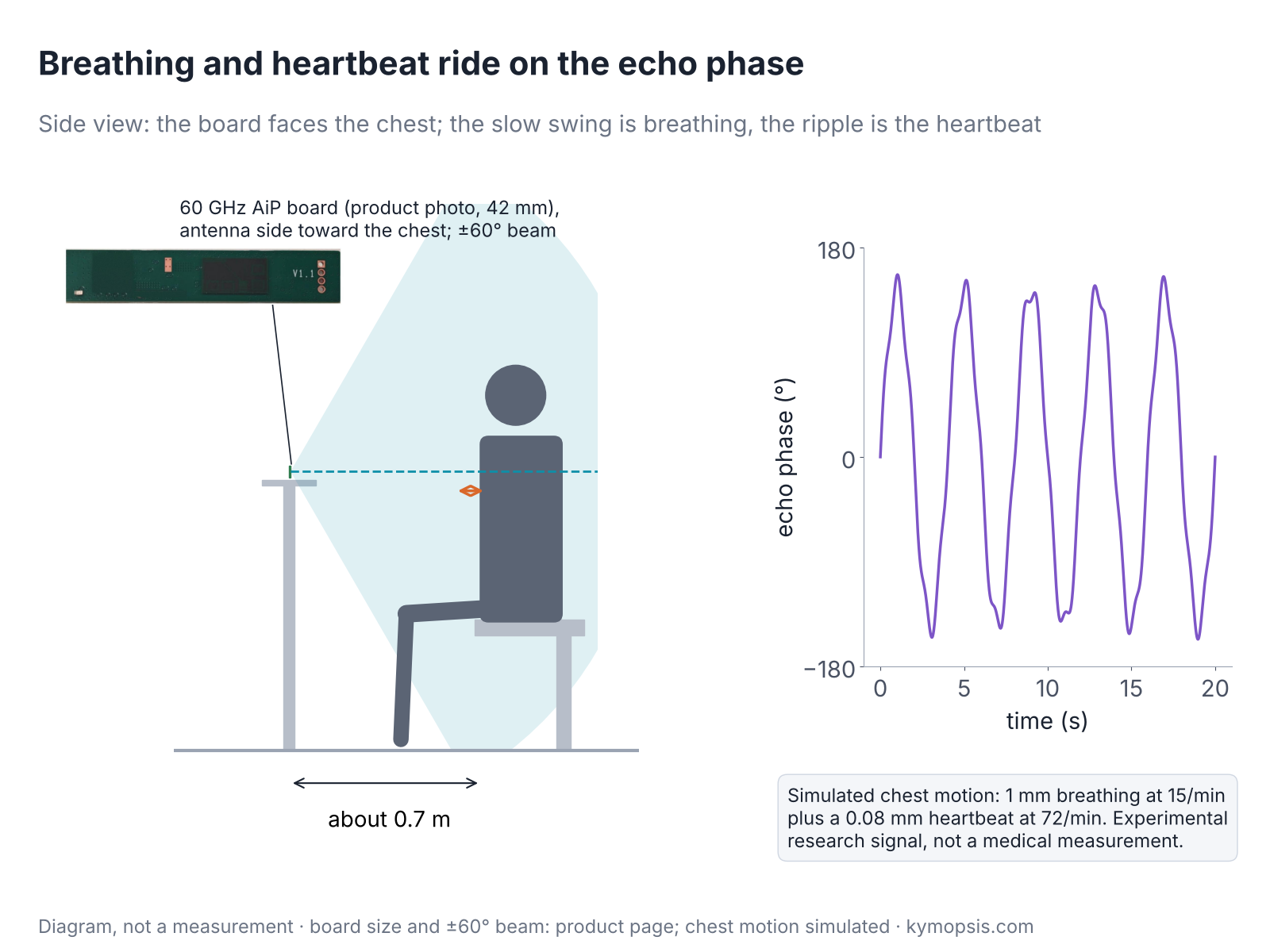

The heartbeat is the hard part. It moves the chest wall by only a few tenths of a millimetre, about 20 dB below breathing, and breathing harmonics fall right in the heart-rate band. Even the idealised simulation shows a peak that is easy to confuse with noise. Research systems use longer records, adaptive filters and models of the breathing waveform to pull it out, and they still need the person to sit still.
What goes wrong in practice
Counting a pulse with two fingers works when the person sits still in a quiet room. If they fidget, talk, or someone bumps the table, you lose count. Radar vital signs fail the same way: a shift in the chair, a second person at the same distance, or a fan nearby drowns the tiny ripple.
- Body motion. Shifting in a chair moves the chest by centimetres, swamping millimetre breathing. Algorithms detect these events and pause the estimate.
- Several people. Two people at the same range and in the same beam add their echoes in one bin and their signals mix. Angle separation (chapter 12) helps.
- Aspect and clothing. The echo comes mostly from the part of the body facing the radar. Thick clothing and a turned body weaken it and change which motion is measured.
- Phase noise and drift. Over tens of seconds, oscillator drift and temperature add slow phase changes that look like motion.
- Unwrapping slips. Sudden motion can make the phase jump more than half a turn between frames and produce a step in the displacement (chapter 9).
For these reasons, every vital-sign result from a development module should be treated as an experiment. The modules and software discussed here are not medical devices and must not be used for diagnosis or monitoring of health.
Try it on hardware
The 60 GHz kits below run gesture and presence processing in firmware, and can also output breathing and heart-rate values as experimental research signals (one person, board above the chest; not a medical device). The spectrograms and the breathing chain in this chapter are reproduced by examples in the open-source radar-basics-sim library, so you can vary the motion, the frame rate and the clutter and see when the method breaks. A simple bench check of any breathing output is to breathe in time with a metronome, for example 12 breaths per minute, while sitting still in front of the board, then compare the reported rate with the metronome and watch what happens when you hold your breath, shift in the chair or let a second person walk past. Those three cases show quickly how much of the method in this chapter a given module implements.
Try it yourself: examples/ch11_micro_doppler.py in the open-source radar-basics-sim repository runs the core simulation of this chapter; change the assumptions and see what moves.
-

60 GHz AiP Gesture & Presence Radar Sensor Module, Pre-flashed (57–64 GHz, 2T2R)
From $19.00Sensor onlySensor + USB-TTL adapter (3.3 V LDO)Reset optionsGesture recognitionPresence, ceiling mountPresence, wall mountPresence and fall events, ceiling mountBreathing and heart rate (research)Select options This product has multiple variants. The options may be chosen on the product page -

60 GHz Gesture & Presence Radar Module Development Kit, PCB Antenna (2T2R, 25 × 31.5 mm)
From $19.00DIY boardDevelopment kitReset optionsGesture recognitionPresence, ceiling mountPresence, wall mountPeople countingPresence and fall events, ceiling mountBreathing and heart rate (research)Select options This product has multiple variants. The options may be chosen on the product page
FAQ
What is micro-Doppler?
The extra Doppler modulation produced by parts of a target moving relative to its main body, such as limbs, rotor blades or a breathing chest. It appears as patterns around the main velocity in a spectrogram.
Can a 60 GHz radar detect a person who is not moving?
Usually yes, through small motions such as breathing and posture sway measured in the echo phase over several seconds. A completely motionless object cannot be told apart from furniture by Doppler alone.
Can radar measure heart rate?
In controlled conditions research systems can estimate it from chest motion of a few tenths of a millimetre. It is fragile and sensitive to movement; development modules are not medical devices.
Why use radar instead of a camera for presence?
Radar works in the dark, through thin covers, and does not record images of people, which matters for privacy in homes and offices.
Sources and method
- V. C. Chen, The Micro-Doppler Effect in Radar, 2nd ed., Artech House, 2019.
- C. Li, J. Lin et al., “A review on recent progress of portable short-range noncontact microwave radar systems”, IEEE Transactions on Microwave Theory and Techniques, 2017 (vital-sign radar).
- M. A. Richards, Fundamentals of Radar Signal Processing, 2nd ed., McGraw-Hill, 2014 (short-time Fourier analysis).
- Figures and animations are computed in Python from the formulas shown; the simulation code is open source in Kymopsis/radar-basics-sim. Motions are simplified models, not recordings of people. Figures marked SIMULATION are not measurements of a product.